Flicker Fusion

There is always a dream that you could write [a program] once and [have it] run anywhere and history has proven that that dream has not been fully realised and I am sceptical that it ever will be

There is always a dream that you could write [a program] once and [have it] run anywhere and history has proven that that dream has not been fully realised and I am sceptical that it ever will be

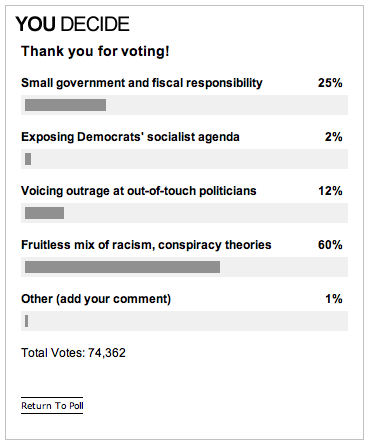
Andy Rubin, VP of engineering at Google, on the recently announced Wholesale Applications Community, a “platform” being backed by pretty much every mobile carrier on the planet. The idea sounds like something akin to Apple’s iPhone app store, only it’s supposed to work across mobile operating systems, devices and carriers. Anyone with even a rudimentary understanding of computing has to see how dumb this idea is.

Also, it’s called WAC. Seriously.
Consumers loudly campaigned for another Barbie® career. The winner of the popular vote is Computer Engineer. Computer Engineer Barbie®, debuting in Winter 2010, inspires a new generation of girls to explore this important high-tech industry, which continues to grow and need future female leaders.

Consumers loudly campaigned for another Barbie® career. The winner of the popular vote is Computer Engineer. Computer Engineer Barbie®, debuting in Winter 2010, inspires a new generation of girls to explore this important high-tech industry, which continues to grow and need future female leaders.

—Nice, the next Barbie is going to be a nerd.

no title

It’s a little hard to hear, but this is the best answer to any Jeopardy question ever.

“Coach K knows all about this 2005 Johnny Knoxville film, based on a TV series”

“What is Jackass?”

The answer they were looking for was Dukes of Hazard but we all know she was absolutely correct.

UCSF neurobiologist Thomas Lewis claims that if we’re not careful, we can trick a part of our brain into thinking that we’re having a real social interaction–something crucial and ancient for human survival–when we actually aren’t. This leads to a stressful (but subconscious) cognitive dissonance, where we’re getting some of what the brain thinks it needs, but not enough to fill that whatever-ineffable-thing-is-scientists-still-haven’t-completely-nailed-but-might-be-smell.

UCSF neurobiologist Thomas Lewis claims that if we’re not careful, we can trick a part of our brain into thinking that we’re having a real social interaction–something crucial and ancient for human survival–when we actually aren’t. This leads to a stressful (but subconscious) cognitive dissonance, where we’re getting some of what the brain thinks it needs, but not enough to fill that whatever-ineffable-thing-is-scientists-still-haven’t-completely-nailed-but-might-be-smell.

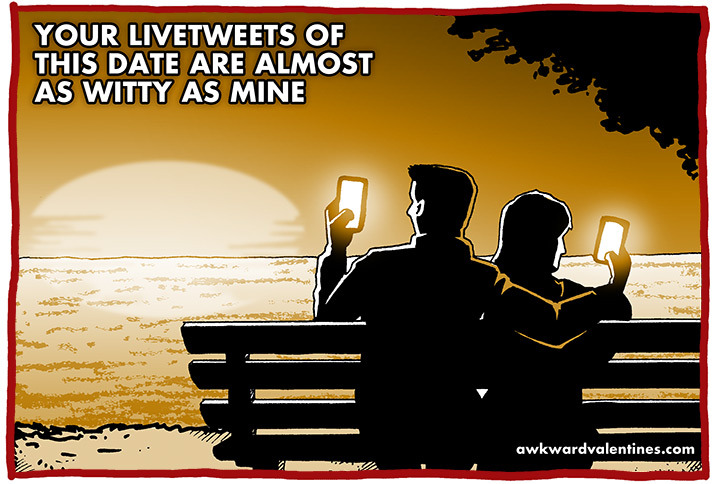
Kathy Sierra thinks Twitter may be too good. As a Twitter fan, some might say apologist, I completely agree that this dissonance is certainly worth paying attention to.

I’ve (lamely) made the point in casual conversation that Twitter seems to kill, well, some degree of casual conversation (so that we end up having meta conversations about our lack of casual conversations), or, at the very least, obviates some of the need for small talk. I don’t think that this is an inherently bad thing, as someone who, frankly, sucks at small talk, but I do think our connectedness is accelerating much more quickly than our macro, societal ability to deal with it. What do you say to someone you meet at a party whom you also follow on Twitter – you already know the answer to the standard “what’s up” after all.

The rest of Kathy’s post, dealing with Twitter as addiction and attention span, is worth a read.